Ground Cover or Open Soil: Two Ways to Read a Planting
Ground cover or open soil shapes how a bed reads and how easily you can see individual plants. Compare the options and plan a layout that fits.
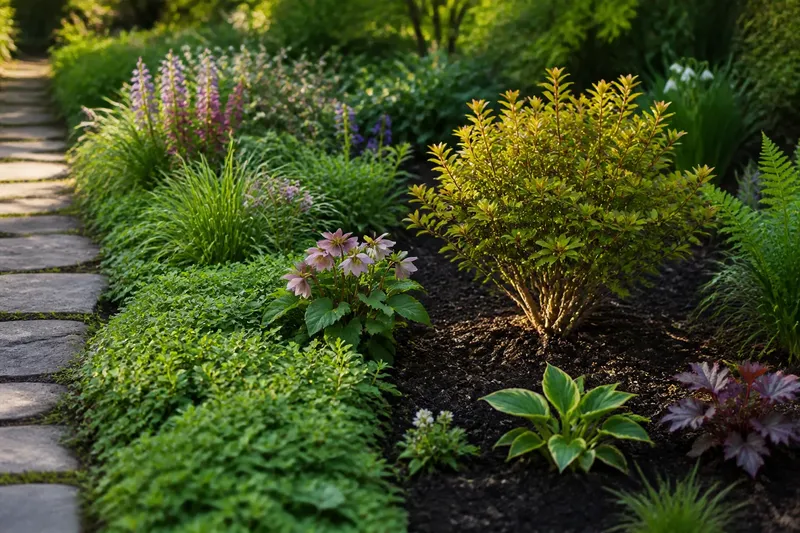
At the edge of a garden path, leaves may meet across the soil while a few steps away dark earth remains visible around a shrub. Ground cover or open soil changes how a planting reads, and the choice affects which plants stand out and how the bed develops.
Think of the soil surface as the spacing between words on a page: it can connect nearby shapes or give each one room to register. Neither arrangement is automatically better. Start with what you want a visitor to notice, then consider how the plants will grow into the space.
Ground cover connects separate plant groups
Ground cover is a low, spreading or closely planted layer that occupies much of the visible soil. It might come from one species repeated across a bed or several compatible plants growing together. Taller flowers, grasses, shrubs or small trees rise above that layer.
A connected surface can make a planting feel cohesive. Repeated foliage links plants that differ in height or form, and a low layer can soften the boundary beside a path. The texture need not be uniform: small rounded leaves create a different effect from upright sedge or arching fern fronds.
The trade-off is visibility. As low plants fill spaces, individual stems and seedlings can become harder to see. Reaching the soil may also disturb neighboring foliage. That can be inconvenient if you often inspect seedlings or adjust the planting.
Choose ground cover when you want a connected, soft-edged impression and the selected plants can share space without crowding larger plants. Check mature spread, light needs and soil preferences on plant labels or nursery guidance. If a plant’s eventual spread conflicts with the role you have in mind, choose a different plant or reserve a more open area.
Open soil makes individual plants easier to see
An open-soil arrangement leaves visible spaces between plants. The gaps might form a regular pattern, a loose scatter or a strip beside a path. Their shape and the soil’s color and texture become part of the design.
Visible openings suit a bed where individual forms matter. A shrub with a branching outline or a perennial with a distinct shape can stand apart when foliage does not meet around every stem. Open spaces can also help a new planting look intentional while its plants are still small.
Gaps do not have to stay empty. Nearby plants may spread, and seedlings may appear. If a precise outline matters, watch the edges and remove or redirect growth that obscures the intended spacing. Narrow slivers between crowded plants are less useful than openings that are easy to see and reach.
Choose open soil when distinct silhouettes, visible spacing or close observation are central to the design. Consider how the exposed surface looks through the seasons, since the bed may feel sparse at some times of year.
A mixed layout gives some plants room and others a link
A bed can combine a low layer with open pockets. Use ground cover where it links plant groups or softens an edge, and leave visible soil around a plant whose outline deserves attention. Rather than scatter gaps at random, decide what each opening helps show.
Say you are planning a narrow border with a low clump of sedge, a flowering perennial and a compact shrub. In your sketch, mark a strip of ground cover between the sedge and the path, then leave an open pocket around the shrub. The expected result is a connected foreground and a more distinct shrub; if spreading foliage blurs the shrub’s outline, trim the edge or keep that pocket more open.
A mixed layout still needs attention as plants grow. Treat the arrangement as a set of relationships, not a fixed grid: a low plant can link one group while a nearby opening gives another plant room to stand apart.
The bed’s scale and setting change how gaps read
Look at the planting from the place where people will usually see it, such as a doorway, window or nearby path. Continuous cover tends to connect separate groups; open patches make them easier to distinguish. A mix alternates between those effects.
Scale matters. A broad opening may look deliberate in a large bed but like a missing plant in a small one. Many narrow gaps can feel fussy, while a few clear openings may make the arrangement easier to read. The plants’ leaf shapes, colors and heights also affect the impression.
Consider the bed’s outline and what lies beside it. A flowing border may suit a connected layer that softens its edge. Repeated clumps or upright forms may benefit from visible intervals. A neat path edge can make open soil look intentional, while ground cover can soften paving if its eventual spread will not make the boundary hard to manage.
Choose a surface arrangement with a clear purpose
Before planting, write down what you want the surface to communicate: a connected green edge, room to see each plant, or a combination of both. Then compare that aim with the plants’ growth habits and how you use the bed.
- Check the intended visual effect: if you want neighboring groups to read as one, use continuous cover; if you want each group to stand apart, leave visible openings.
- Check each plant’s mature spread: if it fits the role of a low link, include it in the covered area; if it may crowd a focal plant, choose another plant or preserve an opening.
- Check your access to plant bases: if you need to inspect seedlings or reach stems, keep those areas open; if not, a connected layer may suit that part of the bed.
- Check how the soil surface looks from the path or window: if small gaps disappear at that distance, widen or group them; if broad openings dominate, reduce them or connect selected areas with ground cover.
- Check the bed’s outline: if a soft border is the aim, let a suitable low layer link the edge; if a crisp boundary matters, keep spreading plants back from the path.
- Check whether each opening has a purpose: if it frames a plant or separates contrasting forms, keep it; if it looks accidental, reshape it or connect it to a nearby opening.
For a simple comparison, sketch the bed as broad shapes rather than drawing every leaf. Shade the intended ground-cover areas and leave openings blank. If the plan connects the places where you want a calm visual flow and leaves room around focal plants, it serves the intended purpose. If every gap seems equally important, decide which ones help the design and revise the rest.
Which surface arrangement suits your planting?
Does ground cover have to be one kind of plant?
No. A continuous visual layer can use one spreading species or several compatible low plants. Choose companions suited to the same light and soil conditions, with growth habits that will not crowd plants rising through them.
Will exposed soil always look unfinished?
No. An opening can look deliberate when its shape relates to the surrounding plants. If it seems accidental, reshape it, change its scale or use a low plant to connect selected areas.
Can I combine ground cover and open soil in one bed?
Yes. Use continuity where it links groups or softens an edge, and retain openings where a plant’s form or spacing deserves attention. The arrangement is clearer when each gap has a purpose.
How do I decide how much space to leave?
Start with the plants’ mature size and the view you want, rather than a universal spacing formula. Sketch broad patches, then compare the plan from the path or window where people will see it.
Ground cover or open soil is a choice about what the planting should make visible: connection, distinction or a blend of both. As plants grow, revisit the layout. An opening may need reshaping, while a spreading edge may link groups more effectively than it did at planting time.
If you are unsure, sketch the bed before deciding which areas to cover. Mark the plants you want to feature, then leave openings around them and connect the groups where a softer edge makes sense. That gives you a clear starting point and room to adjust the planting as it develops.