From Roof to Root: How the Rain Garden Idea Took Shape
Rain garden history is less a single origin story than a change in drainage thinking: follow roof runoff into planted ground and see what the site can accept.
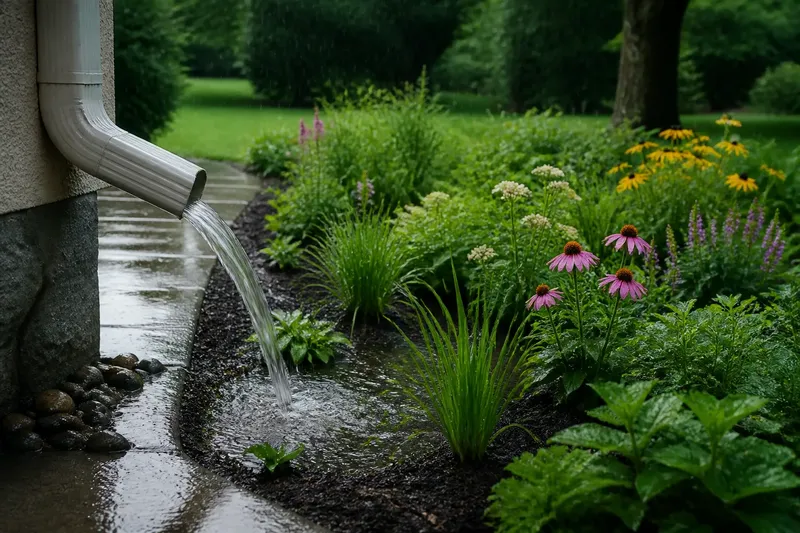
After a shower, a downspout can send a narrow stream across a driveway while a nearby garden bed stays dry. Rain garden history centers on the changing idea that runoff might be guided into planted ground, rather than simply carried away. It is a story of landscape thinking, not one clearly dated invention.
Rain garden history has no single origin point
The term describes a recognizable approach: direct runoff into a shallow planted area where it can spread and soak into suitable soil. That description explains what a rain garden does, but it does not establish one inventor, place, or moment when the idea began. The original article’s broad claim of a historical shift needs that distinction.
People have long shaped land to manage water, but that broad fact is not the same as a documented origin for the modern rain garden. Without specific historical records, it is more accurate to describe the idea’s development as a change in emphasis: from moving water off a property toward considering how the yard might receive some of it.
Drainage systems shaped the question
Gutters, downspouts, paved surfaces, and drains direct rain away from roofs and walking areas. They remain useful for protecting buildings and carrying water along planned routes. The question that opens space for a rain garden comes after the downspout: must all of that runoff leave the yard, or can a suitable planted area receive part of it?
A rain garden does not replace every drain or solve every drainage problem. It adds a possible destination within a larger route that includes the roof, outlet, ground, and whatever lies downhill. That practical connection is more useful than claiming a universal historical turning point.
The garden became part of the runoff route
A rain garden is not simply a flower bed with water nearby. Its placement and shape are chosen so runoff can enter, spread across planted ground, and soak in where the site allows. Soil, roots, and the route water takes all matter; a decorative depression alone does not make the surrounding conditions suitable.
Think of a downspout as a hallway that moves people in one direction. A rain garden is more like a waiting area along that route: it gives water room to spread before continuing into the soil or along an overflow path. The analogy has limits, but it makes the change in landscape role easy to see.
Site observations turn the idea into a decision
Before considering a rain garden, trace the runoff during rain and note where it comes from, where it travels, and what it reaches. Check the ground’s behavior and nearby structures rather than assuming that a low spot is a suitable destination. Local guidance can help clarify soil, drainage, and placement requirements; consult a qualified professional if water threatens a building or neighboring property.
- Check whether the proposed area is downhill from the downspout; if water cannot reach it by a controlled route, choose a different location or keep the existing drainage route.
- Check whether runoff currently flows toward a foundation; if it does, do not redirect it toward the building, and seek local drainage advice before changing the route.
- Check whether the ground accepts water rather than remaining saturated; if it stays wet, consider another site or ask a qualified local professional about alternatives.
- Check what the runoff crosses before reaching the planting area; if it passes over a path or other surface that creates a safety or contamination concern, keep that flow on an appropriate drainage route.
- Check whether water has a safe route if the planted area cannot receive it; if overflow would reach a building or a neighbor’s property, choose another arrangement or get professional guidance.
- Check whether the plants can suit both wetter periods and drier intervals; if the site’s conditions do not fit the intended planting, select plants suited to those conditions or reconsider the location.
Say a homeowner has a downspout that empties onto a paved strip, a garden bed downhill and to one side, and a foundation near the outlet. These are invented starting conditions, not a report of a real site. During rain, the homeowner traces the flow and sees it run along the paving toward the bed, while also checking whether any water pools against the wall. They then inspect whether the bed stays saturated and identify where excess water would go if it could not soak in. If the route can be redirected away from the foundation, the bed accepts water, and overflow has a safe destination, the bed may be a candidate for further planning; if any of those checks fails, the homeowner keeps the existing drainage route and seeks local advice. The observable result to look for after any properly planned change is water entering and spreading through the intended planted area, without being sent toward the building or another property.
Why do rain gardens receive runoff?
Is a rain garden only a flower bed?
It may look like a planted bed, but its purpose includes receiving runoff. The water’s entry route, the ground’s ability to take it, and a safe overflow path distinguish it from an ordinary bed.
Is a rain garden meant to remain full of water?
It is designed to receive rain and allow water to soak into suitable ground, not to serve as a permanent pond. If an area remains saturated or drainage is uncertain, get advice from a qualified local professional.
Can any downspout feed a rain garden?
No. The runoff route, nearby structures, soil behavior, and destination for overflow all affect whether that arrangement is appropriate. A downspout should not be redirected in a way that sends water toward a foundation or neighboring property.
Why plant the receiving area?
Plants make the receiving space a garden, while their roots occupy the soil where water moves. Choose plants suited to the site’s wet and dry conditions rather than assuming every garden plant will thrive there.
A roof and a garden share one water route
The idea took shape as a way to see the yard as part of drainage, not merely the ground beyond a building. That does not establish a precise origin story; it describes the rain garden’s defining contribution to landscape thinking. Roof, downspout, planted area, and overflow become parts of one route.
To understand whether that idea fits a particular yard, follow the water during rain and record where it slows, pools, or leaves the property. That simple observation makes rain garden history tangible: the subject is not only how a garden looks, but how carefully its place in the water’s path has been chosen.